
As demand for polyurethane foam continues to grow, manufacturers face increasing pressure to improve output, maintain consistent quality, optimise material usage, and enhance plant safety. Achieving these goals requires more than higher production capacity. It demands continuous improvements across every stage of the manufacturing process.
With over three decades of experience and installations across 44+ countries, A S Entterprises (ASE) has helped foam manufacturers address these evolving challenges through practical engineering advancements. The innovations explored in this article are designed to solve real production challenges within the polyurethane slabstock foaming process, delivering measurable improvements in yield, consistency, Improved cell structure, and operational efficiency.
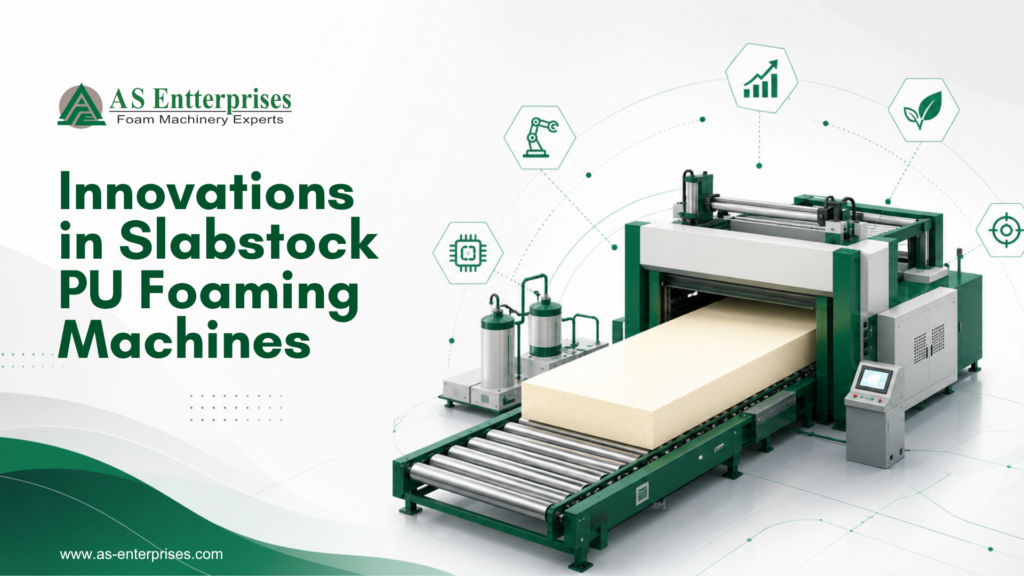
The Changing Landscape of Slabstock PU Foam Manufacturing
Historically, foam plants relied on manual labour, localised controls, and operator judgment. That worked when production runs were long, grades were few, and tolerances were loose. None of those conditions describe the current market.
Manufacturers today are producing higher volumes across more foam grades, with customers expecting session to session consistency and by applying the manual processes the same can’t be delivered. Raw material costs have made yield losses harder to absorb. Safety expectations around chemical handling have risen. Foam production line automation has moved from an upgrade consideration to an operational requirement — plants that haven’t addressed it are running at a measurable disadvantage in yield, consistency, and worker safety, eventually loosing the profit.
Rather than rebuilding from scratch, most manufacturers are retrofitting. Targeted foam plant innovations — advanced liquid laydown systems, automated side-wall controls, high-pressure injection — can be integrated into existing lines without the cost and disruption of a full rebuild.
Key Innovations in PU Foaming Machines
PMAXX Flat Top System
The flat-top profile of a foam block matters more than it might seem. Crowning — where the centre of the block rises higher than the edges during the free-rise foaming process — creates waste.
The PMAXX Flat Top System controls the rise profile during production, producing blocks with a genuinely flat top surface. This isn’t cosmetic. It directly improves material yield by reducing how much has to be removed in the skiving or topping process. For plants running high volumes, the cumulative impact is significant on profit.
YES Technology (Wall Tilt System)
The sides of a foam block bulge outward during free rise — a natural result of the chemistry and containment geometry. Leaving that uncorrected means the outer portions of the block are off-spec. They get cut away.
The Wall Tilt System in ASE’s foam plant advancement compensates for this during production by angling the side walls. The result is block sides that are straight after rise. Plants using YES Technology typically recover 2–3% of material that would otherwise become scrap. In a high-throughput plant, that number translates directly to cost.
NDOFLEX System
Uniform foam quality across the length of a block depends on how the liquid chemicals are laid down at the start of the pour. If the pouring is not aligned — whether due to inconsistent flow rates, turbulence at the nozzle, chemical pressure or poor bottom paper movement — the foam structure varies across the block.
The NDOFLEX System is ASE’s advanced stationary liquid laydown solution. It combines a new pour plate design with controlled bottom paper movement to achieve better distribution of the reacting chemicals. The result is more consistent cell structure across the full block length — which matters especially in slabstock foam production technology targeting specification-sensitive applications like medical or high-resilience furniture foam.
Mag-Drive Pump Technology
TDI handling is one of the areas where the polyurethane slabstock foaming process demands engineering specificity. Conventional pump seals are a chronic leak point. In a plant handling TDI volumes at production scale, even small leaks represent a health hazard, a maintenance cost, and a source of contamination in the foam formulation.
Mag-Drive pumps eliminate mechanical seals entirely. The impeller is driven magnetically, with no shaft penetration through the pump housing. There are no seals to degrade or replace. The result is a contained, leak-free TDI handling system that reduces both maintenance downtime and the risk of operator exposure.
High-Pressure TDI and Water Injection System
Foam quality begins with a precise chemical reaction. Accurate dosing and pressure control of TDI and water are critical to achieving the desired reaction. Even when the formulation remains unchanged on paper, variations in dosing or process parameters can lead to differences in foam hardness, density, and quality of cell structure from one batch to another.
ASE’s high-pressure injection system delivers precise, consistent metering of both TDI and water into the mix head. The injection pressure improves mixing uniformity, which stabilizes the reaction. This produces consistent foam structure not just within a single run but across batches over time — which is what actually matters for a manufacturer supplying to specifications.
Innovations in Foam Cutting Machines
Achieving high efficiency on the foaming line is irrelevant if down-stream cutting processes introduce dimensional errors or material damage. In modern manufacturing layouts, cutting is no longer considered a separate finishing task; it is an integrated process that directly affects total plant yield, product quality, and downstream throughput.
Carousel Cutting Machine – Model NX
For high-volume production of thin foam sheets—such as those used in mattress quilting, apparel lining, and technical packaging—traditional horizontal splitters create significant bottlenecks. Blocks must be loaded, sliced, removed, and reloaded manually.
The Model NX Carousel Cutting Machine solves this by arranging multiple foam blocks on a massive, rotating circular table assembly. The system utilizes advanced servo motors and heavy-duty ball-screw technology to lower the cutting head assembly with micro-millimeter precision after each rotation cycle. As the table spins continuously, the high-speed bandknife slices through multiple blocks without stopping, eliminating the time lost during the reverse-stroke movement found in traditional reciprocating splitters. This setup ensures exceptional repeatability and unmatched thickness consistency across thousands of consecutive sheets.
Circular Cutting Machine – Model S33
Handling large, heavy, un-split foam buns requires significant physical effort and introduces the risk of tearing or damaging the outer surfaces of premium foam.
The Model S33 Circular Cutting Machine introduces high-level automation directly to the slicing stage through fully integrated automated loading and unloading conveyor systems. Large blocks are automatically transferred onto the cutting bed, securely held in place via vacuum or specialized high-friction surfaces, and cut cleanly by an automated circular blade assembly. Once sliced, the sheets are mechanically extracted without requiring operators to pull or lift the material. This automated sequence minimizes material damage caused by manual handling, improves cycle times, and reduces operator dependency to optimize floor safety.
Next-Gen Foam Block Handling and Storage Systems
A 60-metre long block storage system sounds like a logistics solution. It functions as a production quality tool.
Freshly poured foam blocks need to cure before cutting. If that curing happens inconsistently special on a large scale — blocks stacked irregularly, airflow blocked— the foam properties at the cutting stage aren’t uniform. The effects show up as hardness variation within a finished slab.
ASE’s long block storage system uses conveyors and controlled curing racks to move foam blocks efficiently from production to cutting. It reduces forklift traffic, maintains consistent curing conditions, and can be customised to suit any plant layout. The system also improves workplace safety by minimizing forklift movement around workers and large foam blocks.
Conversion Stage Innovations: Trimming and Cushion Cutting
Mattress Trimming Line (MT-2)
After cutting, mattress blocks typically require four-side trimming to bring them to finished dimensions. Done manually or with slower equipment, trimming becomes a bottleneck — especially when throughput at the cutting stage has improved.
The MT-2 trims all four sides of a mattress block within a minute. This keeps trimming in line with upstream production speeds and avoids the queue that builds up when finishing operations can’t match foaming and cutting output.
Cushion Cutting Line
Sofa cushion production requires consistent geometry across large batch runs. Cushions cut slightly out of dimension show in the finished furniture. The gap between the cut cushion and the cover isn’t something a consumer misses.
ASE’s cushion cutting line handles this in continuous flow. Cuts are consistent across shifts and don’t depend on individual operator attention or fatigue state. For manufacturers supplying furniture producers with volume commitments, this matters.
The ASE Design Philosophy: Appropriate Automation
ASE has been building foam machinery since 1989. Equipment developed over that period and installed in plants across 44+ countries doesn’t stay the same — it gets revised based on what actually fails, what operators struggle with, and where output falls short of specification. That feedback loop is where ASE’s design decisions come from.
The consistent principle is appropriate automation: improving what needs improving without introducing complexity that a plant team can’t manage. Not every problem requires a software solution. Not every line needs to be rebuilt. What it does need is equipment that performs consistently under real production conditions — across shifts, across seasons, and across the operational lifetime of the machine.
Safety as a Non-Negotiable Design Requirement
In a polyurethane foam plant, the hazards are specific. TDI is toxic at low exposure levels. Foam blocks are heavy. Cutting equipment moves fast. Managing these risks through operator vigilance alone isn’t a reliable strategy at production scale.
ASE integrates safety requirements at the engineering stage rather than adding them after. Mag-Drive pump technology removes the mechanical seal — the chronic TDI leak point in conventional systems. Automated block handling in storage and cutting reduces manual contact with heavy loads. Smart control interfaces give operators clearer visibility into process conditions without requiring physical proximity to the reaction zone.
Training and maintenance discipline is important too. Well-designed PU slabstock foaming machine combined with poor operating practice still produces incidents. ASE’s support approach addresses this, but the machines themselves are built so that safe operation is the default condition, not something that depends on individual attention.
Conclusion
The innovations covered in this article — from flat-top foaming systems and leak-free TDI handling to automated cutting and long-block storage — aren’t responses to industry trends. They’re responses to specific problems that show up repeatedly in real plants: yield lost to block crowning, contamination from pump leaks, curing inconsistency from uncontrolled storage, bottlenecks at the trimming stage.
ASE’s role, built over 35 years and across installations in 44+ countries, is to develop solutions to those problems and put them into equipment that holds up under production conditions. The continuous slabstock foaming machine of today is more precise, safer, and higher-yielding than what was available a decade ago — not because the engineering was theoretical, but because the feedback came from the factory floor. That’s where it will continue to come from.