
Every polyurethane foam block begins the same way, with a carefully controlled chemical reaction. What happens after that depends entirely on the production system behind it.
Some manufacturers produce foam one block at a time, adjusting formulations as production requirements change throughout the day. Others run a continuous production line capable of manufacturing large volumes with minimal interruption. Both approaches have their place in the polyurethane industry, and both are capable of producing high-quality flexible PU foam. The difference lies in how they support a manufacturer’s production objectives.
Selecting a foaming system isn’t simply about buying a machine with a higher output. The decision shapes production planning, factory layout, manpower, automation, operating costs, and how easily a business can expand later. A machine that works exceptionally well for a growing mattress manufacturer may not be the right investment for a company producing specialized foam grades in smaller quantities.
This article explains how a batch foaming machine and a continuous foaming machine operate, compares their production capabilities, and outlines the factors manufacturers should weigh before deciding which foaming machine to buy.
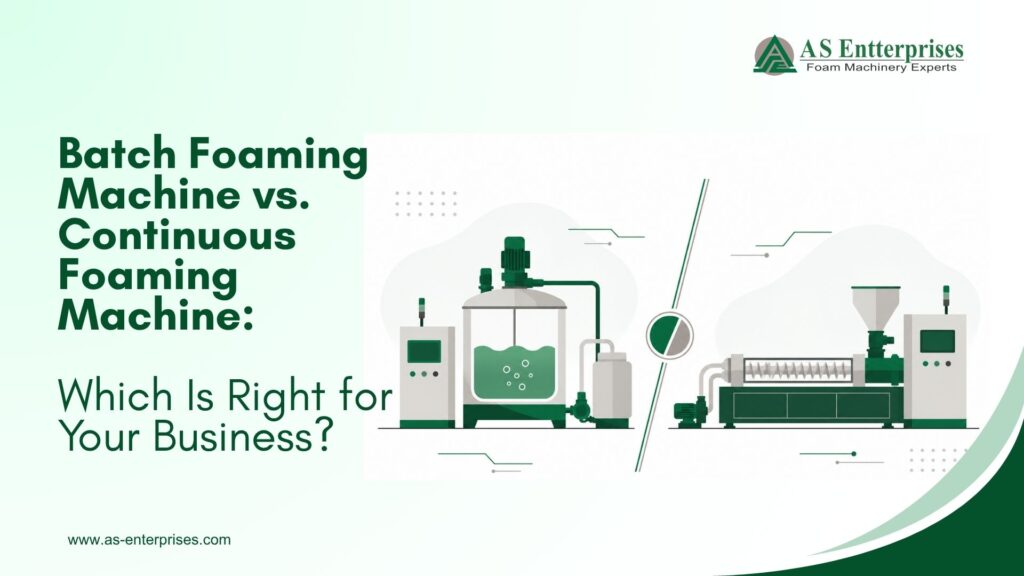
What Is a Batch Foaming Machine?
A Batch foaming machine produces polyurethane foam one block at a time. Each cycle involves measuring the required chemicals, mixing them to the desired formulation, pouring the mixture into a mold or foaming box, and letting the foam expand and to put in its proper place before the next cycle begins.
Since every block is produced independently, manufacturers keep tighter control over individual formulations. Different foam grades, densities, or product specifications can be produced without reworking an entire line.
The typical production process runs through a few stages: measuring raw materials, mixing them in controlled proportions, pouring into a mold or foaming box, allowing the foam to rise, removing the finished block, then resetting for the next cycle. Because production happens in individual batches, there is naturally some downtime between blocks while the system is cleaned, reset, or prepared for the next formulation.
Production Scale. Batch foaming systems generally suit manufacturers with low to medium production volumes, and they hold up well when schedules change frequently or different foam grades need to run through the same day.
Common Industries and Applications. Batch foaming is commonly used for mattress foam in limited quantities, furniture cushions, packaging foam, customized industrial foam, specialty polyurethane products, and R&D applications. The flexibility of batch production makes it particularly useful for businesses that prioritize product variety over maximum output.
What Is a Continuous Foaming Machine?
A Continuous foaming machine is built for uninterrupted polyurethane foam production. Instead of producing individual blocks one at a time, raw chemicals are continuously metered, mixed, and poured onto a moving conveyor, where the foam expands as it travels through the line. The result is a continuous foam slab that is later cut into blocks of predetermined lengths. There’s no need to stop after each block — production continues until the desired quantity has been manufactured.
A typical continuous production workflow moves through automatic chemical storage and feeding, continuous metering, high-precision mixing, continuous pouring onto the conveyor, foam expansion during conveyor travel, curing, automatic cutting into blocks, and transfer to downstream processing equipment. Because the line runs continuously, manufacturers achieve significantly higher output while maintaining consistent foam quality.
Production Scale. Continuous foaming systems are built for medium to very high volumes, and they’re the standard in factories manufacturing foam throughout the day with minimal interruption.
Common Industries and Applications. Continuous lines are widely used for large-scale foam production which may include mattress manufacturing, furniture foam, industrial insulation, packaging materials, construction foam products, and high-volume flexible PU foam. Many large manufacturers looking for a continuous foam machine India rely on fully integrated lines that combine foaming, conveying, curing, cutting, and block processing into one workflow.
Batch vs. Continuous Foaming: Understanding the Key Differences
Although both systems manufacture polyurethane foam, their design philosophy is entirely different. Comparing a Batch vs Continuous foaming machine means looking beyond production capacity alone — manufacturers should weigh how each system performs across several operational areas that shape productivity, operating costs, and long-term scalability.
Production Output
A batch foaming system produces one foam block per cycle, then resets for the next. A continuous production line is engineered for uninterrupted manufacturing, producing foam for extended periods and generating significantly higher daily output as a result.
For businesses supplying large furniture manufacturers or mattress brands, production capacity alone often justifies investing in a continuous line. If demand is relatively modest or varies from week to week, a batch system may provide sufficient capacity without overinvesting in equipment.
It’s also worth separating theoretical capacity from what a line actually delivers day to day. A batch machine’s rated output looks reasonable on paper until changeover time between foam grades, mold cleaning, and manual handling are factored in. A continuous line holds its output rate more predictably because the process isn’t resetting after every block, which is part of why manufacturers scaling toward high-volume contracts tend to move to continuous production sooner rather than later.
Production Speed
Production speed extends beyond how quickly foam is made — it also includes the downtime between cycles. With batch production, mixing is completed separately for each batch, the machine pauses between cycles, and operators prepare the system before the next block begins.
Continuous production minimizes these interruptions. Because chemicals are constantly mixed and dispensed, production continues with very little downtime, which lets manufacturers produce more foam within the same operating hours while improving equipment utilization. For facilities running multiple shifts or meeting high-volume demand, that’s a real operational advantage.
Space Requirements
Batch foaming systems generally need a more compact production area — many facilities accommodate batch production within roughly 10,000 square feet, depending on storage and downstream equipment. Continuous foaming lines need substantially more room, often 2 to 3 acres to support the complete layout.
That additional space covers long conveyor systems, foam expansion zones, curing areas, automatic cutting equipment, material handling systems, storage and logistics, and room for future expansion. Proper space planning matters because the foaming line is only one component of a larger manufacturing system.
Automation and Labor Requirements
Batch systems generally require more operator involvement throughout production — personnel monitor mixing, initiate each cycle, manage formulation changes, and oversee individual batches.
Continuous foaming lines lean much more heavily on automation, typically through automated chemical dosing, PLC-based controls, continuous process monitoring, conveyor integration, and automatic cutting systems. Skilled operators remain essential either way, but automation cuts down on repetitive manual tasks and helps maintain efficient production throughout the day.
Product Consistency
In batch production, each block is manufactured independently, and even with strict process control, slight variations can occur between batches due to raw material handling, environmental conditions, or operational adjustments.
Continuous production minimizes this. Because flow rates, mixing ratios, and process parameters stay stable throughout the run, manufacturers get greater consistency across large quantities of foam — which matters more as production volumes grow, since product uniformity affects both downstream manufacturing and customer satisfaction.
Investment Considerations
A Batch foaming machine typically requires lower capital investment, making it an attractive option for startups, expanding businesses, or manufacturers entering PU foam production. A continuous foaming line represents a larger investment, driven by larger equipment, higher automation, conveyor integration, and expanded production facilities.
That said, investment decisions shouldn’t rest on purchase price alone. For manufacturers producing high volumes every day, increased productivity, reduced downtime, and improved consistency often deliver stronger long-term returns, even after accounting for the higher upfront cost. Production goals, expected demand, and business strategy determine the true return on investment, not the size of the initial quote.
Which Machine Is Right for Your Business?
There isn’t a universally better option because production goals vary from one manufacturer to the next. A machine that delivers excellent results in one factory may be oversized or underutilized in another. Rather than asking which technology is superior, manufacturers should ask which system best matches their production scale, available resources, and future plans.
Choose a Batch Foaming Machine If…
- You’re looking for a lower initial investment
- You produce smaller quantities rather than mass volumes
- Your production schedule changes frequently
- You frequently manufacture different foam grades or specialty products in single schedule
- Flexibility matters more to you than maximum production speed
Choose a Continuous Foaming Machine If…
- Your available resources and infrastructure support large-scale manufacturing
- You manufacture foam in high volumes on a regular basis
- You need consistent production running throughout the day
- You’re planning to automate your existing production facility
- Your business is starting from good volume and preparing for long-term growth
Questions to Ask Before You Buy
Do not sign a purchase order until you and your management team have clearly answered these questions about your facility:
- Resources are required: Do we actually have the land, building height and length, and the funds to support this line?
- Required Electricity connection Load: Do we have the high-voltage grid connection necessary to run these heavy industrial motors?
- Lead times and installation support: How long will it take to build the machine, and who is actually installing it?
- Numbers of Manpower required: Are we going to need skilled technicians or general Labor?
- Operator training provided: Will the manufacturer stay on-site to teach our staff how to actually run the software?
- Spare parts availability and service network: When a pump fails, how many days will it take to get a replacement part?
- Warranty and after-sales support: What exactly does the contract cover if something breaks in the first year?
- Ability to integrate with your existing/planned equipment: Will this new machine work with the cutting saws we already own?
- Scalability: Can this basic batch line or continuous line be upgraded or expanded later as our business grows?
Getting straight answers here often matters as much as the batch vs continuous foaming machine decision itself, since gaps in service support or scalability tend to surface only after installation.
Looking Beyond the Foaming Machine
The foaming machine is the heart of PU foam production, but it’s only one part of the overall process. Once foam is produced, it has to move efficiently through curing, cutting, handling, and storage. If any of those stages run inefficiently, the productivity of the whole factory suffers, regardless of how advanced the foaming machine is.
This is why modern foam manufacturing facilities are designed as integrated production systems rather than a collection of standalone machines. Conveyor systems transfer foam blocks safely between production stages while cutting down on manual handling. After curing, blocks move to cutting equipment — horizontal, vertical, profile, or other block processing machinery depending on what’s being produced.
Material flow between these operations should be planned during the factory design stage, not worked out afterward. Poor layouts tend to create unnecessary transportation, congestion, and added labor, all of which chip away at efficiency. A well-planned layout instead delivers smoother material movement, less manual handling, better use of floor space, and easier expansion down the line.
Think about how a block moves once it leaves the foaming line: into curing, then to a block cutter, then to circular or profile cutting equipment depending on the end product, then into storage or shipping. Each handoff is a point where foam can sit idle or get handled more times than necessary. Planning cutting, curing, and handling equipment alongside the foaming machine, rather than sourcing it separately once the line is already running, tends to save both floor space and labor over the life of the plant. The foaming machine works best when it’s treated as one part of a connected system, not a standalone purchase.
Complete PU Foam Production Solutions from ASE
Choosing the right foaming system becomes much easier when manufacturers work with a partner that understands the complete polyurethane foam production process rather than supplying individual machines in isolation.
With more than three decades of experience in the PU foam industry, ASE has helped manufacturers establish and expand production facilities by designing complete, integrated manufacturing solutions tailored to their operational requirements.
ASE’s portfolio includes:
- Continuous foaming lines
- Batch foaming systems
- Conveyor systems
- Horizontal cutting machines
- Vertical cutting machines
- Carousel cutting machines
- Foam block processing equipment
- Material handling solutions
Rather than focusing solely on machine specifications, ASE works with manufacturers to evaluate production capacity, available space, automation goals, downstream processing requirements, and future expansion plans. This system-level approach helps create production lines that deliver efficient material flow and reliable long-term performance.
Whether a manufacturer is establishing a new PU foam plant or upgrading an existing facility, selecting equipment that supports both present production needs and future business growth is essential for maximising long-term value.
Conclusion
There’s no universal answer to batch vs continuous foaming machine — the right choice depends on your production scale, how your order volumes fluctuate, the space and capital you have available, and where your business is headed. A batch machine offers flexibility and a lower entry point; a continuous line offers volume and consistency at a larger investment.
Before deciding which foaming machine to buy, take a clear look at your current production needs alongside your growth plans for the next few years. That evaluation, more than any single spec on a datasheet, is what determines which system will actually serve your business well.