
In the high-stakes world of polyurethane production, fire is a persistent, inherent risk. The very materials that make foam versatile—polyols, TDI and various blowing agents—are often highly flammable, and the exothermic reaction during the curing process can, if not monitored perfectly, lead to thermal runaway. For polyurethane foam manufacturers, a fire incident is a devastating event that brings operations to a grinding halt.
Once the immediate danger is controlled and safety is restored, manufacturers are faced with a difficult question. What should be done with fire-damaged machinery? The decision is rarely straightforward. It is technical, time-sensitive, and often clouded by pressure to resume operations as soon as possible. Insurance considerations, production commitments, and workforce stability all add layers of complexity.
This article examines that question in depth. It looks beyond surface-level damage and cost comparisons to evaluate how fire exposure affects foam manufacturing machines, where repairs are realistically viable, and when replacement becomes the more dependable path forward. The goal is not to promote a one-size-fits-all answer, but to help manufacturers make informed, technically sound decisions grounded in performance, safety, and continuity.
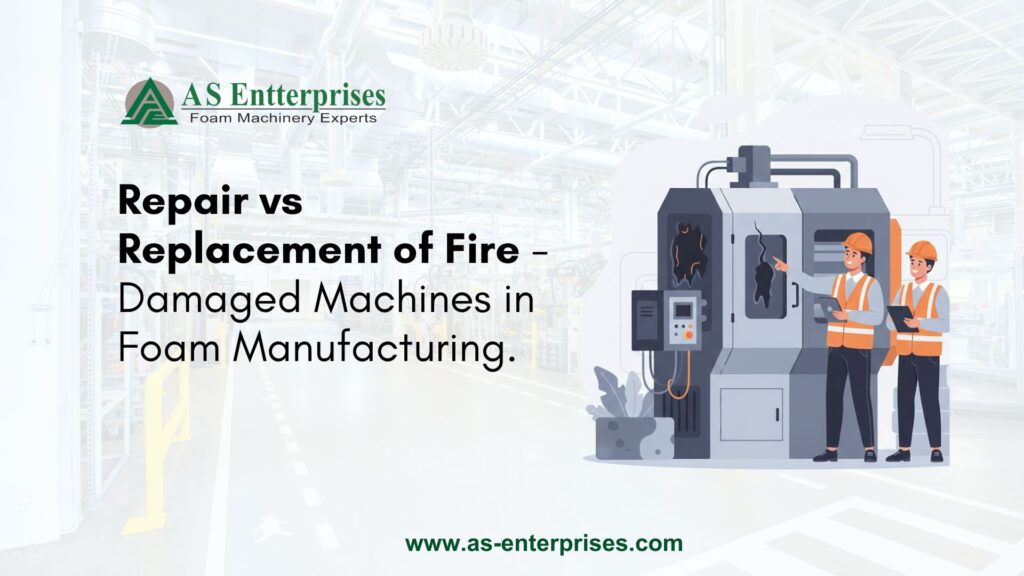
How Fire Exposure Impacts Foam Manufacturing Machines
To the untrained eye, a foam manufacturing machine may appear salvageable if visible damage seems limited to scorched paint or external panels. In reality, fire damage extends far beyond what can be seen. The most severe consequences are often internal, caused by extreme thermal stress rather than direct flame contact.
The Physics of Heat Damage
When industrial equipment is subjected to temperatures exceeding its design parameters, several irreversible changes occur:
- Structural Geometry: High heat causes thermal expansion. If the cooling process is uneven (as is common when fire hoses are used), the metal can warp or “set” in a distorted shape.
- Mechanical Tolerances: Precision machinery relies on tolerances measured in microns. Even miner heat-induced expansion ruins these fits, leading to vibration and premature wear.
- Electrical Integrity: Even if wires aren’t melted, “heat soak” can degrade the insulation of internal components, leading to “ghost” failures and intermittent short circuits months after the machine is put back into service.
Ultimately, these factors lead to permanent performance limitations. A machine that has suffered significant fire exposure may never again achieve the same production speeds or density consistency as a new unit, regardless of how many individual parts are replaced.
Key Areas Most Affected After a Fire Incident
Understanding the specific vulnerabilities of a foam manufacturing machine is essential for any industrial equipment supplier assessing a site. Certain “zones” of a machine are more susceptible to permanent failure than others.
Structural Frames and Load-Bearing Assemblies
The main frame is the backbone of any foam manufacturing machine. It supports moving assemblies, maintains alignment, and absorbs operational stresses. Under intense heat, these heavy-duty welded structures are highly prone to deformation.
Once steel frames are exposed to fire, they often lose their original geometry. Even minor warping can lead to misalignment across the entire machine. While straightening may appear possible, restoring factory-level accuracy is rarely guaranteed. Welded joints are particularly sensitive, as reheating and cooling cycles alter their internal stress patterns.
After a fire, structural accuracy and long-term stability become questionable. A machine may appear straight during static inspection but behave differently under load. For manufacturers who rely on consistent output and tight tolerances, this uncertainty represents a significant operational risk.
Cutting and Mixing Mechanisms
Cutting units and mixing chambers are among the most critical and sensitive components in foam processing. They are also frequently the most damaged in fire incidents.
In many cases, cutting mechanisms are found completely burnt, with blades, guides, and drive systems either fused or distorted. Mixing chambers, exposed to both heat and chemical residues, often suffer irreversible internal damage. Supporting structures, including mounts and housings, are commonly compromised as well.
Partial repairs in these areas rarely deliver reliable performance. Replacing select components while retaining heat-affected structures can lead to uneven cutting, inconsistent mixing, and frequent recalibration requirements. For precision-dependent processes, such outcomes are unacceptable.
Electrical Systems and Controls
Electrical systems are particularly vulnerable to fire exposure. Control panels, wiring looms, sensors, and automation hardware are typically damaged beyond repair, even if flames did not directly engulf them.
Heat degrades insulation, damages circuit boards, and alters signal integrity. As a result, electrical replacement is almost always unavoidable after a fire. However, integrating new control systems into machines with heat-affected mechanical structures introduces additional risks.
Compatibility issues, grounding problems, and unpredictable system behaviour can emerge over time. What initially appears to be a functional solution may instant or later result in intermittent faults and difficult-to-diagnose failures, undermining confidence in daily operations.
Motors, Gearboxes, and Mechanical Drives
Motors, gearboxes, and rotating assemblies are highly sensitive to temperature extremes. Fire exposure often leads to melted seals, degraded lubrication, and warped internal components.
In many cases, parts become fused or jammed, making disassembly both labour-intensive and uncertain. Even when individual components can be replaced, the surrounding housings and mounts may no longer meet alignment specifications.
After repair, mechanical reliability remains uncertain. Increased vibration, heat buildup, and uneven wear are common signs that underlying damage persists. Instantly or over time, these issues translate into higher maintenance demands and unexpected downtime.
The Real Cost of Repairing Fire-Damaged Machines
At first glance, opting for a machine repair after fire damage often appears to be the most budget-friendly route. However, the initial quote for spare parts is rarely the final figure. As a leading industrial equipment supplier, ASE has observed that the financial burden of restoration is often underestimated due to the unpredictable nature of heat-related failure.
Repair Costs Often Escalate Beyond Initial Estimates
In the aftermath of a fire, early damage assessments are frequently superficial.
- The 80/20 Rule of Restoration: Often, visible fire damage represents only about 20% of the true restoration cost. As technicians begin the teardown, they inevitably discover hidden issues: hairline cracks in heat-stressed castings, compromised lubrication channels, and “shadow” damage in components that were not directly touched by flames but were affected by extreme ambient heat.
- Scope Creep: Each discovery necessitates additional parts and specialized labor, quickly turning a “simple repair” into a financial black hole.
Labour-Intensive Handling of Distorted and Fused Components
Repairing a foam manufacturing machine that has been through a fire is significantly more complex than routine maintenance.
- Component Extraction: Heat often causes metal parts to expand and “fuse” together. Removing a seized mixing shaft or a warped drive assembly requires specialized tools, hydraulic pullers, and hundreds of man-hours of delicate labor.
- Precision Realignment: Because frames often warp, technicians must spend weeks attempting to shim, grind, and realign the structure. This level of skilled manual labor is expensive and, unfortunately, offers no guarantee that the machine will ever return to its original “factory-true” state.
Extended Downtime During Repair, Testing, and Recommissioning
For polyurethane foam manufacturers in India, the most significant “cost” isn’t the repair bill—it’s the lost production time.
- Parts Availability: Sourcing obscure or legacy parts for a damaged machine can take months, especially if the original manufacturer is out of part for that specific model.
- The Recommissioning Cycle: Unlike a new machine, a repaired unit requires an exhaustive testing phase. Each “successful” repair must be followed by trial runs, which often reveal new electrical or mechanical glitches triggered by the initial heat soak. This “start-stop” cycle can double or triple the expected downtime.
Hidden Expenses That Reduce the Apparent Cost Advantage
When you look at the total cost of ownership (TCO), the “savings” of a repair often vanish.
- Increased Maintenance Post-Recovery: Repaired machines typically have a much higher “Mean Time Between Failures” (MTBF). You may save on the initial purchase, but you will pay for it through frequent emergency repairs and lower energy efficiency for years may to come.
Operational Risks After Repairs
Even if a repair is technically “successful,” the machine is rarely the same as it was before the incident. Polyurethane foam manufacturers in India must compete on quality; a compromised machine makes this impossible.
- Output Consistency: Structural distortion affects the accuracy of the pour and the stability of the conveyor. This results in “off-spec” foam that must be sold at a discount or scrapped.
- The Breakdown Cycle: Fire-damaged machines enter a cycle of “maintenance-heavy” operation. When one part is fixed, the stress is transferred to another weakened component, leading to frequent, unpredictable shutdowns.
Factors Manufacturers Should Consider Before Deciding
Before committing to a path of fire damage and restoration or opting for a complete replacement, polyurethane foam manufacturers in India must conduct a cold, objective assessment. This decision should not be driven by the emotional urgency to restart production, but by a data-driven evaluation of the machine’s long-term viability.
Extent of Structural Deformation
The structural integrity of the main frame is the single most critical factor in this decision.
- The Tolerance Threshold: If the heavy-duty steel assemblies have warped beyond a few millimeters over their total length, the machine is technically compromised.
- Alignment Risks: A warped frame means that the conveyor, mixing head, and side walls will never perfectly align. This leads to uneven chemical distribution and forming, which results in significant material waste. If the “skeleton” of the foam manufacturing machine is twisted, no amount of new parts will restore its original accuracy.
Degree of Electrical and Mechanical Damage
A modular assessment of the machine’s “nervous system” and “muscles” is essential.
- Electrical Saturation: If the control panels were subjected to direct flame or high-pressure water, the internal circuitry is likely ruined. Replacing an entire PLC system and rewiring a complex machine is often nearly as expensive as buying new.
- Mechanical Integrity: Check for “heat-soak” in high-precision areas like the mixing pump and gearbox. If the mechanical damage exceeds 40–50% of the machine’s value, the labor costs for machine repair after fire damage usually make restoration an unwise investment.
Long-Term Operational, Safety, and Cost Implications
Finally, look at the Total Cost of Ownership (TCO) over the next five years.
- The Insurance & Safety Factor: Will your insurance provider offer the same premiums for a fire-repaired machine as they would for a new, certified installation from a reputable industrial equipment supplier?
- Maintenance Trajectory: Statistics show that fire-damaged equipment requires 30-40% more annual maintenance than new equipment. When you factor in the cost of spare parts, specialized technician visits, and the gradual loss of energy efficiency, the “savings” from a repair are often neutralized within the first two years of operation.
Importance of a Detailed Machine Evaluation
A professional assessment goes beyond a simple visual “walk-through.” It involves specialized diagnostic experience to check for metallurgical fatigue and alignment precision. For polyurethane foam manufacturers in India, an expert evaluation identifies the “hidden killers” of machinery—such as micro-cracks in the high-pressure manifold or the crystallization of chemical residues inside heat-soaked valves—that a general contractor might miss.
Guidance Based on Structural Strength and Long-Term Reliability
Decisions in the wake of a disaster should never be guided by short-term urgency. While the desire to “get back to work” is strong, the primary metrics must be structural strength and long-term reliability.
- Integrity First: If the core frame of the foam manufacturing machine has lost its temper or structural “memory,” it is no longer a safe or productive asset.
- The Reliability Gap: An expert will calculate the “Reliability Gap”—the difference between the performance of a repaired unit versus a new one. If this gap is too wide, the machine will eventually fail during a critical production run, costing more in the long run than a replacement ever would.
Assessing Realistic Production Expectations
The final question an expert helps answer is: Can this machine still do the job? This involves stress-testing the remaining components to see if they can handle the high-torque and high-pressure demands of modern foam chemistry. If a machine repair after fire damage cannot guarantee 99% uptime, it does not meet the realistic expectations of a modern manufacturing facility.
Choosing Reliability and Assurance with ASE
At ASE, we understand that a fire is more than a mechanical failure—it is a business crisis. As a premier industrial equipment supplier, our goal is to provide a roadmap back to profitability, not just a quote for new hardware.
ASE’s Objective Post-Fire Assessment
Our approach is rooted in engineering data. When ASE technicians arrive on-site, they perform a rigorous audit of the affected equipment. We don’t just look at what’s broken; we look at what’s weakened. Our objective assessment provides a transparent “Health Score” for your machinery, allowing you to see exactly where the risks lie.
Clear Guidance for Dependable Performance
We believe in radical honesty. If our assessment shows that machine repair after fire damage will result in a “compromised” asset that will plague your facility with downtime, we provide clear, documented guidance on why a repair is a high-risk gamble. We prioritize your long-term dependable performance over a quick, temporary fix.
Why Manufacturers Opt for New ASE Machines
Manufacturers seeking stability and market leadership often choose to transition to new ASE equipment rather than fighting with a fire-damaged ghost.
- Next-Gen Technology: A replacement from ASE introduces the latest digital flow meters, energy-efficient motors, and advanced PLC interfaces that weren’t available a decade ago.
- Guaranteed Precision: With a new ASE machine, you are guaranteed the micron-level accuracy required for premium foam grades.
Replacement as a Strategic Investment
Smart manufacturers view a post-fire replacement as a strategic investment rather than a “sunk cost.” By moving to a new ASE system, you aren’t just replacing a tool; you are upgrading your facility’s capability, reducing chemical waste, and securing your production line for the next 15–20 years. In the world of fire damage and restoration, the smartest move is often the one that leaves the damage entirely in the past.
Manufacturers considering long-term strategic investment can contact ASE here : https://www.as-enterprises.com/contact.html
Conclusion
Post-fire recovery is a test of a manufacturer’s resilience and foresight. While the impulse to save money through machine repair after fire damage is understandable, it is often a false economy. The hidden costs of structural instability, electrical glitches, and constant maintenance can quickly surpass the investment required for a new system.
In the competitive landscape of polyurethane foam manufacturing, your equipment is your competitive edge. Prioritizing reliability over short-term savings ensures that your facility doesn’t just “restart,” but thrives. Investing in a premium, well-engineered machine from a trusted industrial equipment supplier is the surest way to turn a crisis into an opportunity for modernization.