
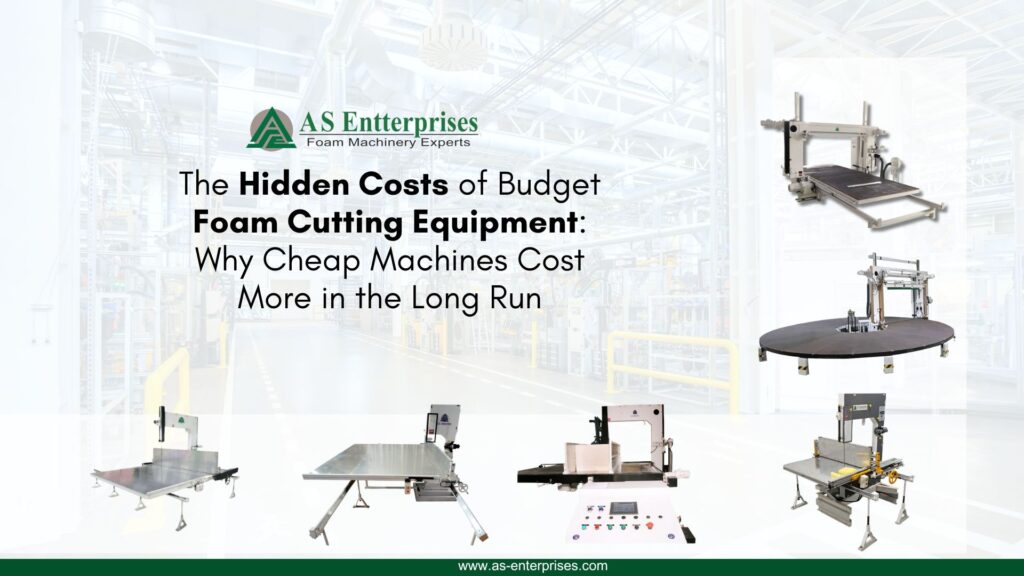
The Hidden Costs of Budget Foam Cutting Equipment: Why Cheap Machines Cost More in the Long Run
In polyurethane foam manufacturing, operational efficiency is not optional. It directly determines profitability, delivery reliability, and long-term competitiveness. For manufacturers setting up a new production line or expanding capacity, investing in foam cutting equipment is one of the most critical capital decisions they will make.
Budget machines often appear attractive at this stage. Lower upfront pricing, shorter lead times, and basic functionality can make them seem like a practical choice. In many cases, procurement decisions are driven by the assumption that cutting foam is a straightforward mechanical process and that lower-priced machines can deliver comparable results.
However, experience across the industry consistently shows a different outcome.
At A S Enterprises, manufacturers frequently approach us after encountering persistent operational challenges linked to low-cost machines. Initial savings are gradually offset by rising maintenance costs, inconsistent output, increased material waste, and production downtime. Over time, these hidden costs often exceed the original price difference between budget equipment and a well-engineered industrial solution.
This article examines where those costs originate and why high-quality polyurethane foam machinery should be evaluated as a long-term operational asset rather than a short-term expense.
Upfront Savings vs Long-Term Spending
There is an important distinction between purchasing a low-price machine and owning equipment with a genuinely low operating cost.
Budgetfoam cutting equipment is designed primarily to minimise initial purchase price. This is typically achieved through lighter frames, basic motors, cheap electrical systems, and limited control architecture. While these choices reduce upfront expenditure, they also limit durability and long-term stability.
By contrast, a well-built industrial foam cutting machine prioritises structural integrity, component reliability, and service life. Although the initial investment is higher, performance remains consistent over extended periods of continuous operation.
The difference becomes clear when lifespan is considered. Budget machines often show noticeable wear within a few years, particularly in high-throughput environments. Motors operate closer to their limits, cutting systems lose alignment, and frame rigidity gradually degrades. A properly engineered PU foam cutting machine, with routine maintenance, can operate reliably for significantly longer without performance deterioration.
Low-grade components are where early savings are most quickly eroded. Bearings wear prematurely, sensors lose calibration, and electrical faults become more frequent. Each failure introduces repair costs and production disruption. Over time, these recurring expenses often surpass the initial savings that motivated the purchase.
Maintenance Costs: What Budget Machines Don’t Reveal
Maintenance is unavoidable in any manufacturing environment, but the frequency and severity of maintenance events vary greatly depending on machine quality.
With budget foam cutting equipment, maintenance often shifts from planned servicing to reactive intervention. Common failure points include cutting blades with unstable tensioning, motors prone to overheating under high-density loads, sensors that drift out of tolerance, bearings susceptible to vibration-related wear, and electrical systems affected by dust, heat, or voltage fluctuation.
Individually, these issues may appear manageable. Collectively, they create unpredictable maintenance cycles that disrupt production planning and inflate annual operating costs.
A further challenge is spare parts availability. Many low-cost machines rely on non-standard or inconsistently sourced components. When failures occur, parts may not be immediately available, leading to extended downtime or costly emergency procurement. Technical support is often limited, leaving internal teams to troubleshoot complex issues without manufacturer assistance.
ASE machines are designed to reduce maintenance frequency through reinforced frames, stable cutting assemblies, and reliable electronics. Components are selected to operate within safe margins, maintain alignment, and deliver consistent performance over time, reducing both the frequency and severity of maintenance events with proven track records.
Downtime: The Most Expensive Hidden Cost
Downtime is one of the most underestimated costs in foam manufacturing.
When a foam block cutting machine is offline, the financial impact extends beyond the cost of repair. Labour continues to be paid, production schedules are disrupted, and delivery commitments come under pressure. In industries such as mattress manufacturing, furniture production, and automotive supply, even short delays can have cascading effects across the supply chain.
Budget machines tend to introduce uncertainty into daily operations. Unplanned breakdowns, unstable calibration, and inconsistent cutting performance make it difficult to maintain predictable production cycles. Operators and supervisors are forced to build buffers into schedules, reducing overall efficiency.
A high-quality industrial foam cutting machine enables predictable operation. Maintenance can be scheduled during planned intervals, and production output remains consistent across shifts. Reduced downtime protects revenue, stabilises workflows, and supports reliable order fulfilment.
Over time, the cost of downtime associated with lower-quality equipment often outweighs the original savings made at purchase.
Material Waste and Inaccuracy: Where Money Quietly Disappears
Raw material represents one of the largest ongoing costs in foam manufacturing, making cutting accuracy critically important.
Budget foam cutting machines often struggle to maintain precision across varying foam densities and thicknesses. Structural instability, vibration, and inconsistent feed control contribute to dimensional variation. While these deviations may appear small, they accumulate rapidly in high-volume production.
Quality PU foam processing machines typically maintain tight tolerances across the full length of a cut. Budget machines are more likely to experience gradual drift, particularly as components wear. A seemingly modest increase in material waste, even in the range of a few percentage points, compounds with every production cycle.
To illustrate the impact, consider a facility cutting several hundred linear metres of foam per day. A small increase in waste translates into material loss every shift, every week, and every year. Over time, this becomes a substantial financial drain.
Inaccurate cuts also affect downstream processes. Poorly dimensioned sheets increase rework, complicate assembly, and reduce overall product consistency. In some cases, parts must be discarded entirely.
ASE machines are engineered for consistent accuracy through stable blade guidance, rigid structural design, and reliable sensing systems. By maintaining dimensional consistency, they help manufacturers reduce scrap rates and protect material value throughout the production process.
The Hidden Cost of Limited Capabilities
Another often-overlooked limitation of budget PU foam manufacturing machines is restricted capability.
Low-cost machines typically offer basic controls, minimal automation, and limited adaptability. Fixed cutting speeds, manual adjustments, and simplified interfaces reduce flexibility and increase dependence on operator intervention.
Handling different foam densities presents additional challenges. Quality machines automatically adjust parameters to suit material characteristics, while budget machines rely on trial-and-error adjustments. Some materials may be unsuitable altogether, limiting the range of jobs the facility can accept.
Long production runs further highlight these constraints. Premium machines maintain stable parameters throughout extended cycles. Budget machines are more prone to drift, requiring ongoing supervision and increasing the risk of quality variation.
Over time, increased labour involvement and reduced efficiency raise operating costs and limit scalability.
Replacement Cycles: Buy Twice, Pay Twice
Machine lifespan is a key determinant of long-term value.
Low-cost foam cutting equipment often has a shorter operational life, particularly under continuous production conditions. As wear accumulates and reliability declines, replacement becomes inevitable.
Replacing a machine involves more than purchasing a new unit. It includes:
- Decommissioning Costs: Removing the old machine and prepping the floor.
- New Installation: Rigging, electrical setup, and calibration.
- Training: Lost time while staff learns a new interface.
Premium machines, including those produced by ASE, are designed to maintain reliable performance with routine upkeep. By the time a budget machine user is buying their second or third unit, the ASE customer is still running their original machine at peak performance, having long since recouped their initial investment.
Total Cost of Ownership (TCO): Budget vs Premium
To truly evaluate the investment, we must look at the Total Cost of Ownership (TCO) across several key factors.
- Purchase Cost: While the budget machine wins on the initial price, this is the only category where it holds an advantage.
- Maintenance and Repair: Budget machines require more frequent parts and technician visits, significantly increasing the cost over 10 years.
- Material Waste: The precision of a premium CNC foam cutting machine saves a fortune in raw material costs that the budget machine would have turned into scrap.
- Energy Usage: Premium machines often utilize more efficient motors and drive systems, reducing the monthly utility bill—a cost that adds up over thousands of hours of operation.
- Downtime and Productivity: The reliability of a high-quality machine ensures maximum “up-time,” allowing you to process more foam in less time.
- Lifespan: A machine that lasts 15 years is three times as valuable as one that lasts 5 years, purely from a depreciation standpoint.
- After-Sales Support: The value of having an expert partner like ASE to ensure your machine stays optimized is immeasurable compared to the “radio silence” often experienced after purchasing a budget machine.
When these factors are viewed holistically, the ASE machine consistently proves to be the more economical choice.
Why ASE Machines Become a Long-Term Asset
ASE machines are designed with a long-term operational mindset, shaped by more than three decades of hands-on experience in foam manufacturing. Having worked through multiple technology shifts and real production challenges, ASE applies this accumulated knowledge to machine design, ensuring performance remains stable under continuous industrial use.
Build quality and process discipline play a central role in this longevity. ASE follows structured, ISO-certified quality and safety standards, with every machine tested thoroughly before dispatch. This focus on consistency and accountability reduces early failures and ensures machines perform as expected in real production environments.
The durability of ASE equipment is also reinforced by its wide installation base. With machines operating across India and in more than 40 international markets, ASE designs systems that can handle varied regulatory requirements, material characteristics, and operating conditions. This exposure results in machines that are adaptable, robust, and reliable over long service lives.
Ongoing development further strengthens long-term value. ASE maintains in-house research and development capabilities and actively incorporates customer feedback into design improvements. Practical inputs from operating facilities help refine machine performance, ease of maintenance, and operational flexibility over time.
Component quality is another key factor. ASE sources critical electrical, control, and mechanical components from globally reputed manufacturers, ensuring reliability, availability, and consistent performance. The use of proven industrial-grade components supports stable operation and extends the usable life of the equipment.
Together, these factors position ASE machines as long-term production assets, capable of supporting consistent output, controlled costs, and evolving manufacturing requirements over many years.
Conclusion
Low-costfoam cutting equipment may reduce initial expenditure, but it often introduces hidden costs that erode profitability over time. Maintenance challenges, downtime, material waste, limited capability, and early replacement all contribute to a higher Total Cost of Ownership.
Manufacturers evaluating new equipment should look beyond the purchase price and consider long-term operational performance. When assessed through this lens, high-quality machinery represents not an expense, but a strategic investment.
By delivering durability, precision, and reliable support, A S Enterprises positions itself as a long-term partner for foam manufacturers seeking consistent output, controlled costs, and sustainable growth.